

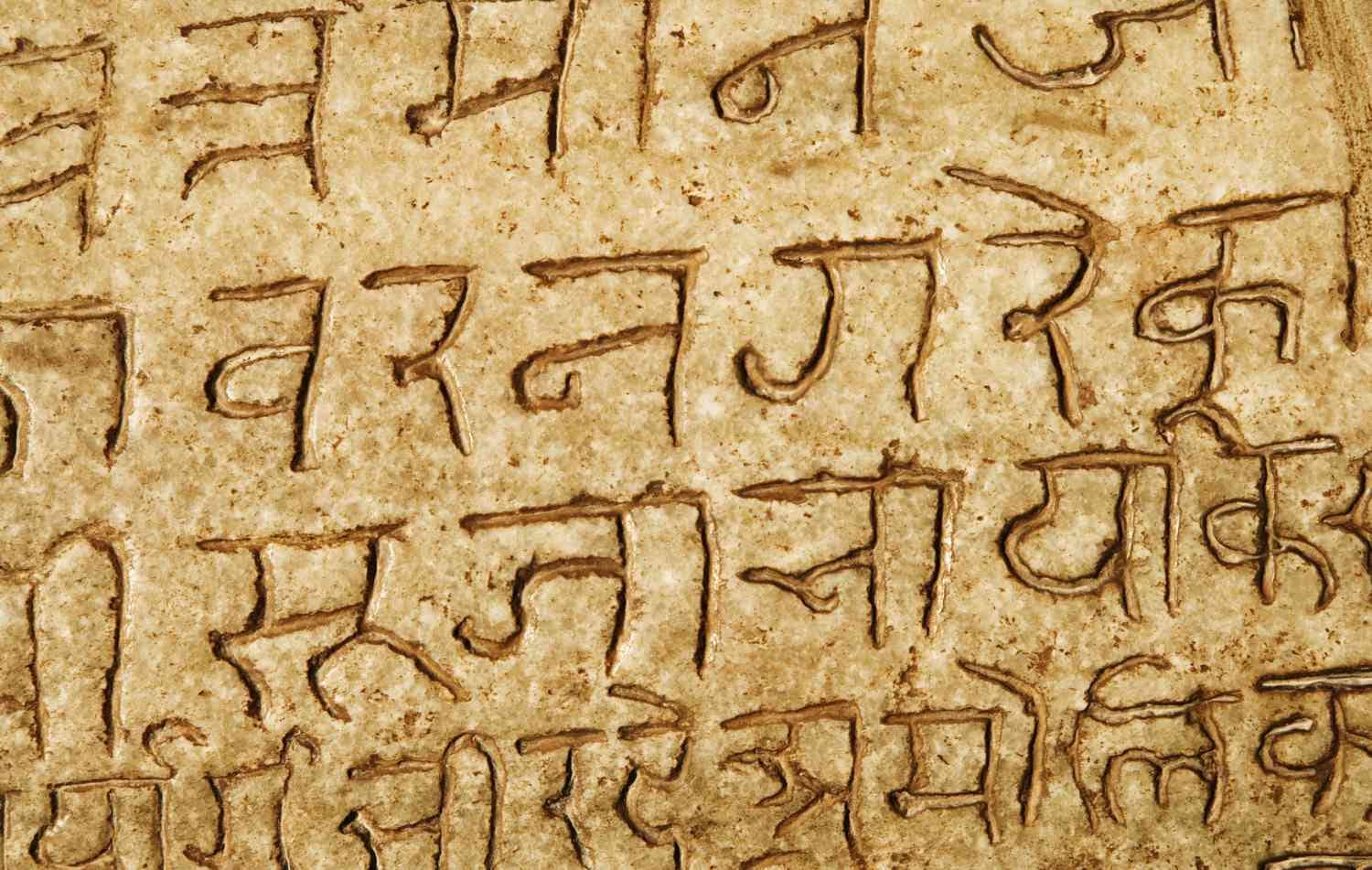
A pervasive mythology encountered in yoga communities and spiritual seekers who become enamoured with Sanskrit is the idea that Sanskrit is a divine, magical language that is, in many instances, ‘untranslatable.’ While there is a kernel of truth to this when we look to the theories of sacred speech (mantra) and the ‘linguistic mysticism’ of non-dual Śākta-Śaiva Tantra, taking this idea of a ‘divine language’ to the extreme amounts to an obscurantist over-mystification of the Sanskrit language.
While the spiritual teachings discussed in Sanskrit treatises can indeed be profound, divine, and mysterious, the grammatical form and interpretive techniques that are employed to explain or articulate ideas, principles, and perspectives are incredibly precise and largely coherent. Because the language is so codified (and for such a long period of time commentators followed the same grammatical rules and styles of interpretation), with sufficient time and a healthy dose of discipline, the Sanskrit language can be effectively learned – as much as any ancient language with so much available literature can be learned. To over-emphasize the ‘mystical’ nature of Sanskrit is therefore an ‘orientalist’ projection that places an unnecessary roadblock on the path of understanding and inadvertently rehearses the fantasy of an ‘exotic East.’
The Sanskrit language in its long and fascinating history was a cosmopolitan language of literary, religious, philosophical, and ‘scientific’ cultures that includes texts and treatises on topics we would today categorize as both ‘sacred’ and ‘secular.’ While, yes, the perspective of many Sanskrit philosophers was that Sanskrit derives from a divine source (the Veda), it is important to situate this perspective within an explanatory context that highlights the role that sound and language play in the cultivation of worlds through which we perceive, conceive, and make sense of our lived experience. To extend what is referred to as a “non-dual” theory of language to its logical conclusion, it follows that all languages ultimately derive from this divine, non-discursive ‘power’ of dynamic sound, pulsation, and articulation. However, the ‘unity’ of this sonic reality does not negate — but rather includes — the diversity of all discursive languages as the variable manifestations of a singular ‘vibratory’ reality.
While the source of all language is, from this perspective, ultimately ‘unmanifest,’ the discursive forms that a ‘non-discursive’ reality ‘brings into being’ structures itself into coherent ‘language-games’ that can be analyzed, studied, and understood.
When one begins to take an interest in Sanskrit, one of the first observations one makes is just how different and complex it is by comparison to many modern languages. This ‘alienness’ is evident in other ancient languages as well, because ancient languages are often extremely different at the level of their grammatical structure. Therefore, what at first may appear profoundly ‘mystifying,’ through deeper study is revealed to be otherwise. Because an ancient language is so different from what we are used to, the grammatical structure and the hermeneutical styles can feel beyond the reach of our understanding. Therefore, to reach beyond our current locus of understanding presumes a willingness to expand the coordinates of our imagination.
Learning any language can entail the development of a different ‘way of seeing’ or quality of perception that was not expressed (and is as such ‘unknown’) within our own linguistic context. This ubiquitous truth of language learning – that ‘the limits of our language are the limits of our world’ – becomes even more demonstrably true when studying a language that includes more words for ideas and modes of perception than those available in our native tongue. Therefore, one might say that the study of any language can produce a kind of ‘spiritual experience,’ if we understand by ‘spiritual experience’ an instance when the locus or orbit of our perception has been expanded or clarified.
Learning Sanskrit grammar and syntax, while central to the classical pedagogy through the study of Pāṇini’s grammar (the Aṣṭadhyāyi) is an unwieldy place to start for most beginners – unless one happens to have previous training in classics and the study of ancient Greek and Latin (which cultivates a familiarity with non-modern grammars). Sanskrit syntax is one of the hardest things to master, partly because a sentence’s syntax can often be elliptical: it omits a word or phrase from a given sentence, because it has been discussed in a previous sentence and is therefore implied. Due to this difficulty, it is understandable that one would first opt to focus on developing their vocabulary; and to do this, Sanskrit students turn to available dictionaries.
When you begin looking at dictionaries for unfamiliar words, a common observation is that there are many meanings associated with a given word. While this is absolutely true, there are important considerations to keep in mind that help to narrow down the possibilities when it comes to translating a word in Sanskrit.
As the previous allusion to ‘syntax’ implies, the most important ruler with which to measure the validity of a word’s meaning is the “context.” The context in which we find a word or phrase being articulated is the key to what differentiates a more or less ‘accurate’ translation from an ‘inaccurate’ one. When we say it is ‘accurate,’ we mean that it approximates or conveys a meaning that coheres with the intention of the author or commentator.
To approach this ‘ruler’ with greater clarity, we can consider context at a number of levels:
The context of a sentence’s meaning in which we find the word (given by the syntax of the sentence);
The context of the intended meaning or purpose of the text as a whole;
The context of the lineage and tradition of knowledge it is situated in; and
The historical period and worldview from which it derives.
We can look to our own language for examples of why context is so important. One example for the first level (the whole sentence) can be illustrated by the word ‘bank.’ If someone was translating English in 5000 years when all the English-speakers are presumably gone – and this future being looked up the word ‘bank’ in a dictionary – they would find at least two possibilities. Considering the whole sentence – either “I’m going to the bank to deposit a check” or “The river overflowed its bank” – reveals the meaning.
So when we do translation work, often we have to work ‘backwards’ from a larger context of understanding. If we zoom in on a particular word and solely consult the dictionary, it becomes more difficult to tease out which meaning is intended.
Someone might respond here, “what about sūtras? I’ve learned that aphoristic texts are intrinsically obscure, and one sūtra or aphorism is not always constructed like a sentence, and therefore many meanings can be derived from it.”
This is true, which is why sūtra texts are almost never found without a commentary (bhāṣya). The purpose of a commentary is to provide an interpretation of a text, and commentators use a codified hermeneutical style that serves five different functions: (1) word-division (padaccheda), (2) stating the meaning of words (padārthokti), (3) analysis of grammatical complexes (vigraha), (4) constructing the sentences (vākyayojanā), and (5) the answering of objections (ākṣepsamādhāna).
While beginning Sanskrit students do not typically work with commentaries (because they can be quite challenging and technical), when one’s skills have developed, commentaries provide an important context for sussing out the meaning of words. The second function of a commentary – padārthokti – establishes the meaning of words by stating the word and then following it with a synonym. For example, in English, we could clarify the meaning of ‘post’ by saying ‘post, as in pillar’ instead of ‘post, as in an assigned role.’ We find the same clarifying tactic used in commentaries, albeit obviously written in Sanskrit.
The interpretation of words found in commentaries can differ, depending on the commentator, which is why there is the fifth function of a commentary – the ‘answering of objections.’ If a commentator disagrees with another commentator about a word’s meaning (or their philosophical rendering), they state the competing interpretation, then give reasons why it is insufficient, and argue why they have chosen another interpretation. Because the reasoning they employ must be consistent with ‘tradition,’ according to the classical perspective, they have to defend their interpretation through methods that are accepted as valid by the tradition. One common device leveraged in the service of ‘answering objections’ is therefore the accepted technique of etymological derivation.
While the vibrational source of all language is considered infinite, practically speaking the ‘seeds’ of this eternal linguistic ‘fabric’ appear as finite. Such seeds ‘manifest’ for the Sanskrit language as roots (dhātu). From the perspective of the grammatical tradition, then, all Sanskrit words are derived (or derivable) from a relatively consistent enumeration of these grammatical roots. Sanskrit philosophical commentators (almost without exception) thus use an etymological derivation style called nirvacana to innovate and transform a word’s meaning – thereby remaining ‘faithful’ to the tradition. Tracing how a chosen meaning is consistent with Sanskrit grammar is thus one important way that commentators demonstrate their consistency with the eternal Veda, because these roots are often understood to be emanations of the transcendent Veda. By showing how a particular meaning is etymologically derivable from one of Sanskrit’s roots is a strategy for conceptual innovation that is justified by demonstrating that the meaning was ‘there all along.’
This interpretive strategy helps commentators restrain their own projections and distortions, while at the same time harnessing a form of conceptual creativity that remains internal to the methodology of the tradition itself. By contrast, to interpret a word in a way that simply reflects creative assumptions stemming from one’s cultural situatedness alone (amounting to a kind of ‘wish-fulfilment’ that selects what ‘works for me’) would be out of alignment with the traditional method. Interestingly for modern translators, learning the rules of etymological derivation allows one to potentially provide their own ‘gloss’ on a word’s meaning — as one way in which the tradition can be inhabited as ‘alive’ is by participating in the same hermeneutical operations that would be consistent with the tradition’s commentarial style and structure.
When we consult a Sanskrit dictionary, in many instances we are looking at a word that has been used over centuries of history. The variable and sometimes contradictory meanings found in dictionaries often reflect the ‘semantic drift’ of a word’s meaning over time. Dictionaries, therefore, ‘flatten’ all these historical layers and can thus be misleading. This is why it is always clarifying to consult the historical and philosophical context, so that our translation work bears a closer resemblance to the intended meaning of its authors and the worldviews and lineages they were committed to defending. Doing translation first – without some initial or accompanying study of the traditions and ideas themselves as offered by scholars, lineage-holders, and devotional leaders – makes translation a much more arduous task that is easily prone to distortion. This does not mean, however, that the modern translators and scholars are always ‘correct’ (they are, like everyone, prone to error), but without understanding (and perhaps embodying) the methods of the tradition, our objections may reflect desires and beliefs that say more about us than the text or tradition itself. As is evident in the commentarial tradition, if we don’t know how others have interpreted the texts or tradition, it is much more difficult to situate ourselves so as to object to them.
All this being said, it is true that even after we grasp the variable layers of context and what the commentaries argue, there can still often be more than one option for how a word is translated. However, often these options are more or less ‘synonymous,’ and therefore choosing one or another doesn’t necessarily change the ‘essential’ meaning being conveyed. Instead, the diversity of synonyms enables a translator to provide a different ‘flavor’ – an opportunity for the translator to infuse their translation with a grounded degree of creativity and ‘poetic flair.’
Sanskrit is a fascinating and complicated language, but we do ourselves a disservice in our efforts when we assume it is intrinsically mysterious or mystical. It can be precise, coherent, and technical, as much as it can be wildly poetic, rich in metaphor and imagery, and ever-inspiring to the human imagination.
As yoga or meditation practitioners, when we make a decision to study Sanskrit, a huge initial hurdle arrives when we notice just how challenging it is to learn. Many will opt out of this challenge, deciding they were more interested in honing pronunciation skills so as to support their practice of chanting. For those that choose to meet the challenge, fruits are born through sustained attention and a long-view of the learning process. Like with mastery of any subject, instrument, or technique, the effects arrive cumulatively over time, through the repetitive pursuit of clarity and refinement.
While the horizon of knowledge may be as yet unknown, the landscape reveals its many contours and caverns to the degree that we remain curious and open to discovering them. Some will be content and comfortable at home in a geography of the familiar. Others will be captivated and inspired by the ever-unfolding wonder of knowing – relishing reality not as a stable, unwavering crop of meaningless objects, but as a deliciously alive and blissfully pulsating beatitude.
As a beginning Sanskrit student- I see how the “mystification” has stopped many practitioners of yoga etc from even starting to study the language. They think it’s enough to “feel the vibration.” This can be true, perhaps?
It’s too bad, though, in so many ways- there are so many layers that I enjoy even where I am- admittedly, just a scratch beneath the surface. Meter, for example. It blows my socks off. I look at iambic pentameter now and think, “how nice…”
Also samāsa (which, to me, does feel like a topic particularly open to interpretations…).
When we posture as “experts” in a yoga/tantra tradition, but have never read the texts closely (well, maybe the yoga sūtras) and don’t know any of the language, for me, it feels like colonization 2.0. There can be so much arrogance there… “what the texts are reaaallly saying…”
These pronlems are not just Western. For me, I had already been studying Tantra for several years, but the “translation” to the text I was reading (by another school of Indian philosophy) was so clearly being appropriated within the lens of that school that I finally had had enough and realized I needed to roll up my sleeves and actually love the thing that I so clearly loved.
A great article and it has inspired me to keep loving that thing (as I’m about to pop in to a Sanskrit class actually!)
Good reflection. Thanks